

Manual Carbonation Machine Durability and Cordless Advantages
Retail buyers rarely lose money on unit price alone. They lose it on warranty claims, returns, and the slow‑moving inventory that follows a quality failure. That is why the durability of a manual carbonation machine deserves more attention than a spec sheet allows.
This guide compares two models built on our own lines — the HR‑185 manual machine and the HR‑198 electric machine — and shows why the simpler mechanical design generally outlives its powered counterpart.
How a Manual Carbonation Machine Works
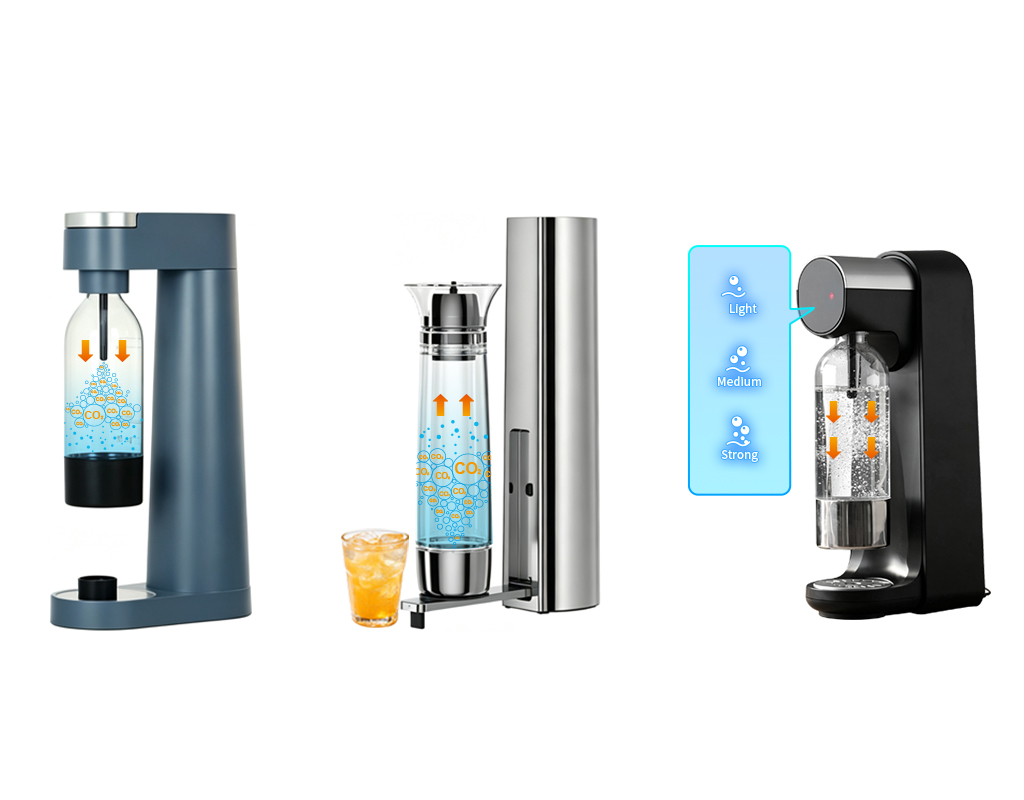
Press the handle and a lever‑actuated mechanical valve releases CO₂ from the cylinder into the 1 L bottle. The machine works between 0.5–0.9 MPa, and a pressure release safety valve protects the system if the user keeps pressing. Fizz strength sits entirely in your hand: a few presses for a light sparkle, more for stronger carbonation.
Now look at what the machine does not contain. There is no motor, no control board, no sensor, no battery, and no power adapter. The housing is molded ABS, selected for impact resistance, and wearing parts are limited to food‑grade seals, O‑rings, and the valve assembly — low‑cost items you replace instead of scrapping the unit.
How an Electric Carbonation Machine for Water Works
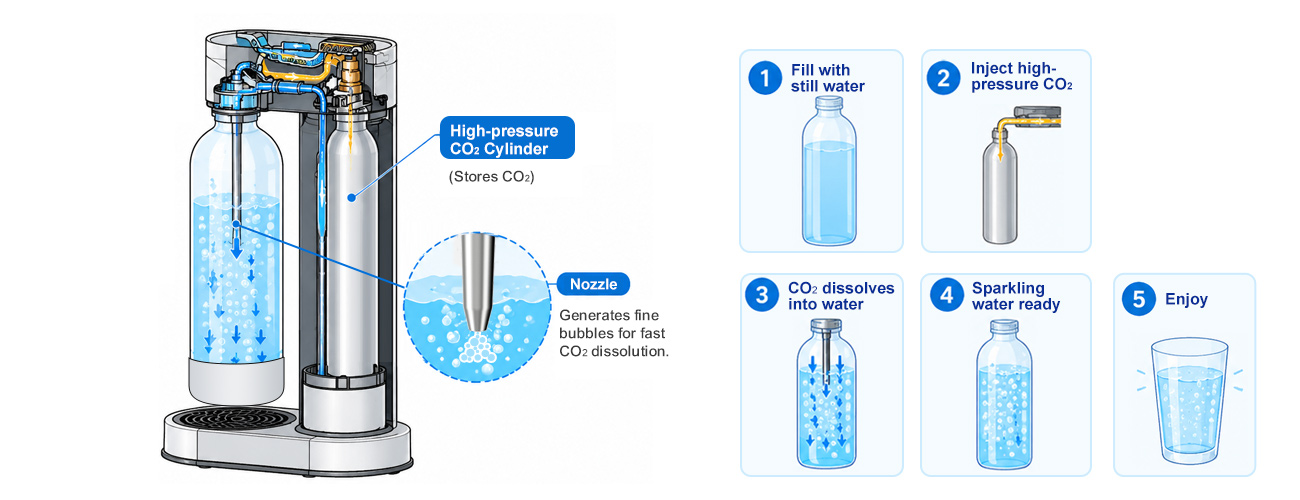
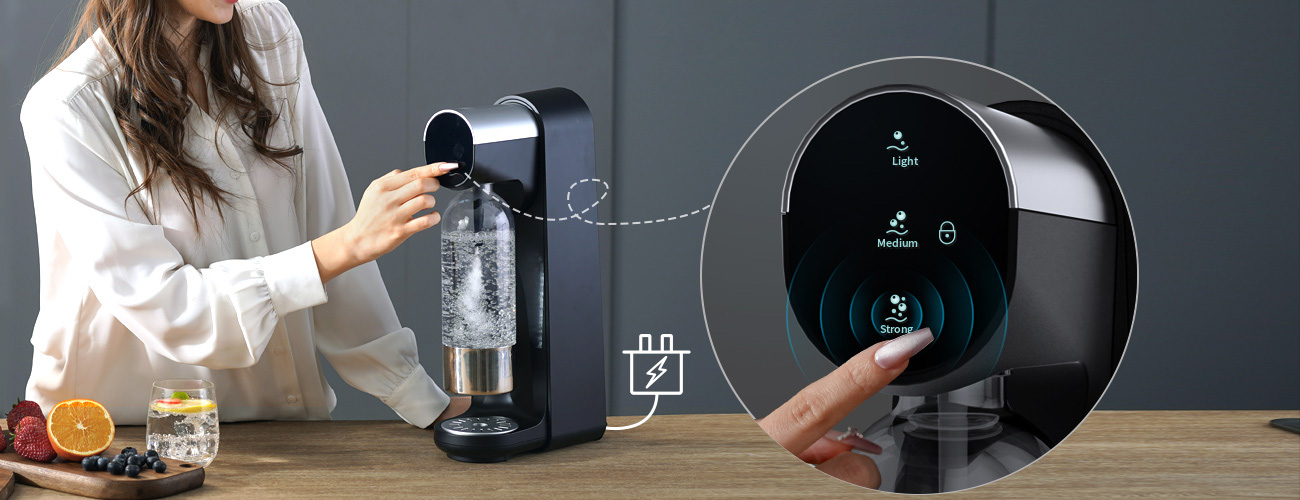
The HR‑198 takes the opposite route. A push‑button control signals an electric pump and solenoid valve, which injects CO₂ to a set pressure while a control board manages the sequence. It runs on an adapter and carries an LED display that shows operating status. The benefit is real: one‑touch operation and consistent carbonation with no effort from the user.
That benefit carries a structural cost. A carbonation machine for water in this category adds a motor, a control board, sensors, wiring, and a power supply to the bill of materials. Each is a potential failure point that adds to the cost of the unit and any repair.
Why a Manual Carbonation Machine Lasts Longer: Six Engineering Reasons
Durability here follows from the design, not from marketing. Six reasons explain why the mechanical route outlives the electric one.
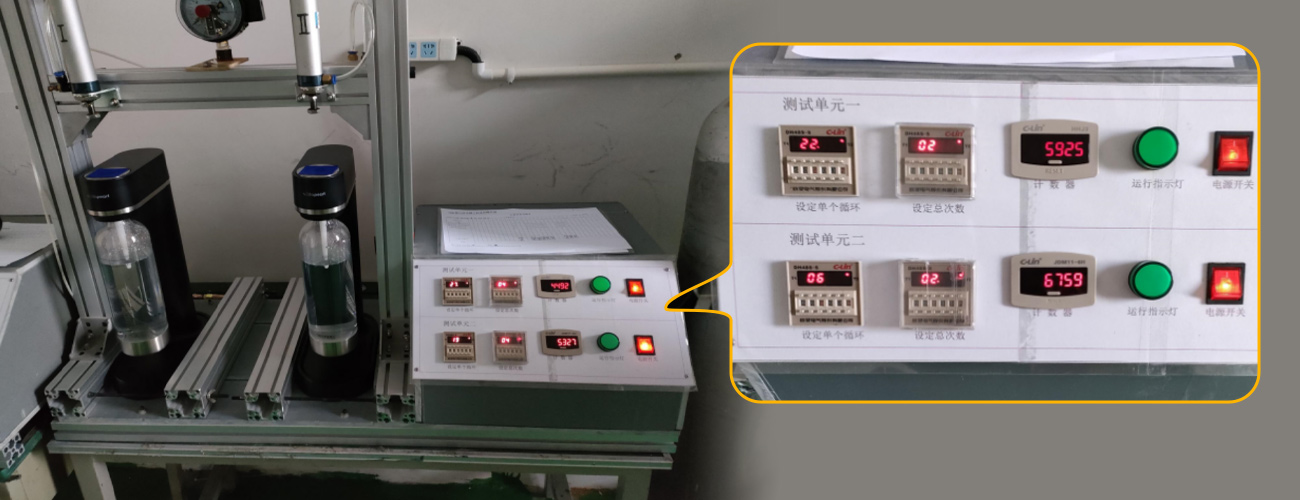
These reasons are not theoretical. In factory lifespan testing, the HR‑185 completed 5,000 cycles with no abnormal change in working pressure, in the CO₂ content of the carbonated water, or in the CO₂ cylinder. The report is available on request.
- 1. Fewer failure points. Every added component adds a chance of failure. A mechanical machine removes four whole categories of potential failure — motor, control board, sensor, and power supply.
- 2. No batteries or capacitors to age out. Lithium batteries degrade with every charge cycle, and electrolytic capacitors have a finite service life. A mechanical design holds no parts that expire on a schedule — which matters most in products stored unused for months.
- 3. Load‑bearing parts are mechanical. Force passes through the lever and valve body rather than through electronics, so wear is predictable and slow. Reviewers make the same point when they note that simpler builds hold up better than complex ones (Taste of Home).
- 4. No electronics to fear moisture. Kitchens are humid, and outdoor use brings rain, splashes, and condensation. A machine without a circuit has no short‑circuit or corrosion path to fail along.
- 5. Repairability. A failed electric unit often needs a pump assembly or control board — ordered parts and skilled labor. A mechanical machine usually needs a seal or valve replaced, keeping service cost and downtime low.
- 6. No standby drain, no storage decay. Nothing to unplug, nothing to charge, nothing to remember before the season starts.
Together, these six factors reach the buyer as warranty claims avoided, lower return rates, and retail partners who reorder.
Cordless Freedom: Where a Water Machine for Sparkling Drinks Wins
Removing the power cord changes where a product can be sold and used.
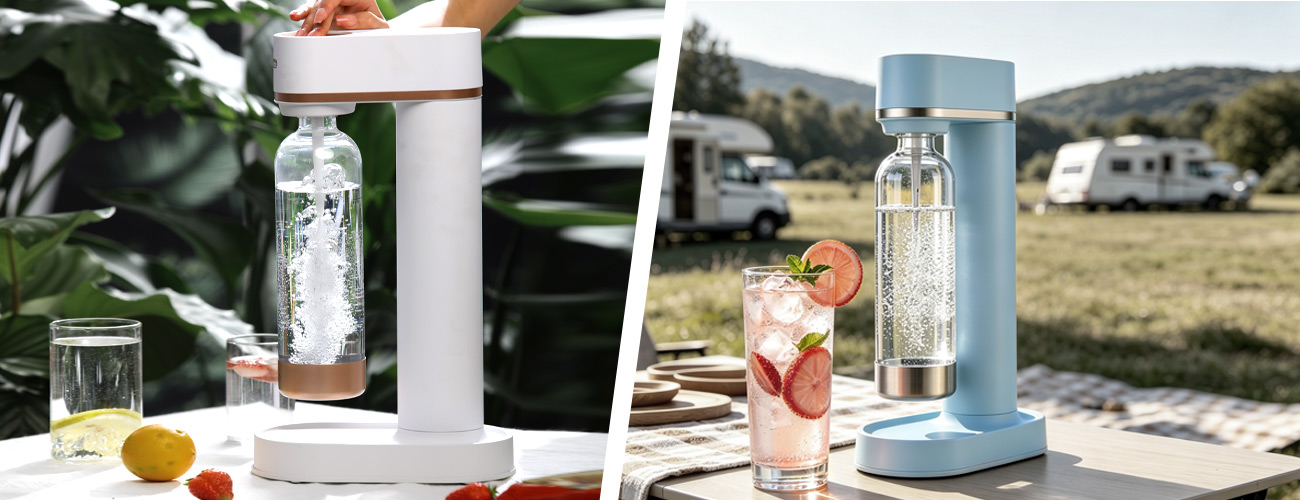
- Outdoor and semi‑outdoor use. A cordless unit works on a campsite, in a camper van, on a boat, or on a market stall with no outlet nearby — a point that matters for outdoor and travel retail.
- No socket limitation. Consumers can place the unit anywhere on the counter, including small apartments where outlets are crowded. Reviewers note that manual models are portable and need no electrical outlet (The Spruce Eats).
- One version for many markets. Without an adapter, there is no plug standard or voltage question to solve per country, and no lithium‑battery transport requirements to manage. A smaller, lighter carton also lowers freight and warehousing cost. Manual designs are widely described as simple, electricity‑free, and more affordable (The Telegraph).
- A retail‑friendly energy story. With no standby consumption, channel partners get a simple efficiency message.
- Gift and promotional channels. A cordless machine that works straight from the box is an easier gift item to retail than one that needs charging.
Why New Brands Choose a Carbonation Machine for Water as Their First SKU
For a startup or a brand entering the category, the commercial case is as strong as the technical one.
- Lower unit cost, lower entry threshold. A shorter parts list and no power supply mean a lower landed cost, leaving room to price competitively at retail.
- Cheaper market testing. A mechanical model lets a new brand enter with an accessible first order, learn what the market accepts, then scale. Ask us for MOQ and sampling terms.
- Broader channel fit. One SKU serves supermarket entry ranges, gift assortments, outdoor channels, and promotional bundles.
- Predictable after‑sales cost. Fewer failures mean fewer warranty claims — the number that decides whether a retail partner reorders.
Which Water Machine for Sparkling Water Fits Your Market?
Match the model to your channel rather than to a general preference.
| Dimension | HR‑185 (Manual) | HR‑198 (Electric) |
|---|---|---|
| Power | None required | Adapter; LED display |
| Working pressure | 0.5–0.9 MPa | 0.5–0.9 MPa |
| Housing and bottle | ABS housing, 1 L bottle | ABS housing, 1 L bottle |
| Structure | No motor, no control board | Motor, control board, sensors |
| Carbonation control | Manual, by hand | One‑touch, pre‑set pressure |
| Best channel | Supermarket entry, gift, outdoor, first SKU | Premium ranges, convenience‑led shoppers |
| After‑sales risk | Low; simple replaceable parts | Higher; electrical components |
| Unit cost positioning | More accessible | Higher |
As a rule of thumb, choose the manual model when durability, price, or outdoor use drives the decision, and the electric model when one‑touch convenience comes first. Many brands carry both — a mechanical entry SKU and an electric premium line.
Request a Quote for Your Water Machine for Sparkling Water
Send us your target market, channel, and volume and we will recommend the right configuration plus the documentation you need to decide. Ask for the HR‑185 datasheet, the 5,000‑cycle test report, and samples; we typically return a technical proposal within 48 hours.
Whether you are launching a first manual carbonation machine or adding an electric line, tell us what your market needs and we will build the quote around it.