

LFGB & FDA Food Safety Standards for Household Soda Maker
Before sparkling water reaches the consumer's lips through five material contact points — cylinder valve, machine tubing, nozzle, soda bottle, and sealing ring. If any one of those points leaches chemicals, loss of consumer trust is irreversible. Yet most buyers equate "BPA-Free" with food safety, when compliance actually demands dozens of tests across multiple material families.
Hongfeng Precision commissioned TUV Thuringen Shanghai to validate every food-contact material in its soda machine maker lineup — producing a 21-page LFGB report (May 2025) and a 7-page FDA report (June 2024). Five materials, 40+ test items, 45+ covered models, and one outcome: PASS.
Why Every Household Soda Maker Needs Food Safety Testing
A household soda maker is fundamentally different from a standard kitchen appliance. Unlike a rice cooker or blender, it produces liquid consumed directly — and that liquid sits inside the soda bottle under acidic conditions (pH 4–5) for up to 24 hours when refrigerated. Acidic CO₂ water is a stronger leaching agent than tap water, meaning migration from every plastic, rubber, and silicone part inside the household soda maker must be tested under real-use conditions.
This is why the LFGB standard includes a sensory test no other major framework demands. If any component releases even trace odor or taste into the drink, LFGB flags it. A household soda maker that passes LFGB has proven it adds nothing perceptible.
LFGB vs FDA: Two Standards Every Soda Machine Maker Must Meet
The European LFGB and American FDA frameworks approach food safety from complementary angles. A responsible soda machine maker must satisfy both.
| Dimension | LFGB (Germany / EU) | FDA (United States) |
|---|---|---|
| Governing regulations | EU 1935/2004 + LFGB §30/31 + BfR + (EU) No 10/2011 | 21 CFR 177.1630, 177.2470, 180.22 & 181.32, 177.2600 |
| Test scope | Sensory exam + overall migration + heavy metals (18 elements), primary aromatic amines (31 compounds), BPA, phthalates (9 compounds), PAHs (15 compounds) + material-specific tests | Evaporation residue, chloroform-soluble extractives, acrylonitrile monomer, total extractives |
| Stringency | Among the world's toughest — includes sensory testing | Mandatory North American market entry |
| Hongfeng status | All items PASS | All items PASS |
The difference in regulatory philosophy matters for any soda machine maker targeting global markets: LFGB asks "does anything detectable migrate into the drink?", while FDA asks "do specific substances stay below safe thresholds?" A soda machine maker that passes both has answered both questions with laboratory evidence — not marketing claims.
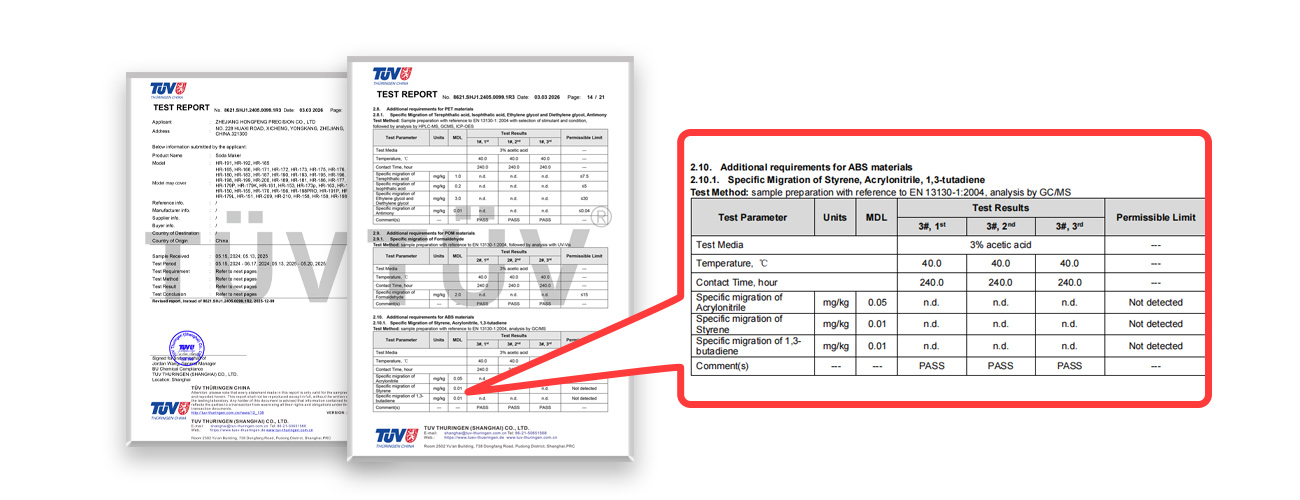
What the LFGB Report Reveals About Soda Bottle and Component
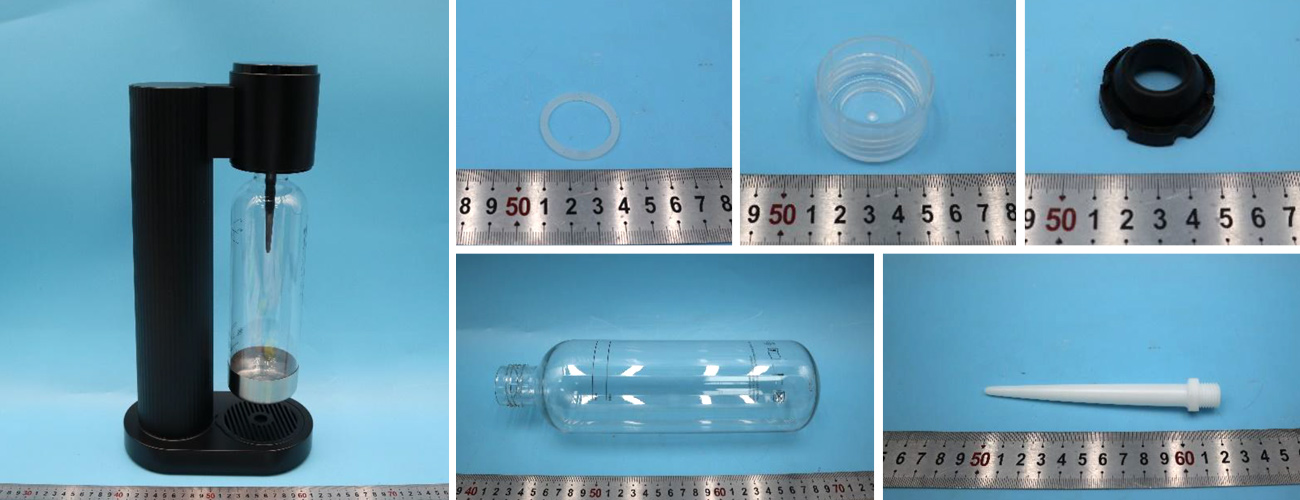
The LFGB report tested five material types — transparent PET soda bottle, white POM plastic, transparent ABS plastic, semi-transparent silicone rubber, and black rubber — across three successive migration rounds at 40°C for 240 hours in both acidic and alcoholic food simulants. Key findings:
- Overall migration: Every material, every simulant, every round: not detected against a 10 mg/dm² limit.
- Heavy metals — 18 elements: Lead, cadmium, mercury, arsenic, antimony, chromium, nickel, cobalt, and others — all not detected across all materials and rounds. For PET specifically, antimony was below the 0.01 mg/kg detection limit (cap: 0.04).
- Primary aromatic amines — 31 compounds: Benzidine, 4-aminobiphenyl, 2-naphthylamine, and 28 other known or suspected carcinogens — all not detected at 0.002 mg/kg MDL. This is a critical safety signal: many small manufacturers skip this test entirely.
- Bisphenol A: Specific migration not detected (<0.05 mg/kg); total content not detected (<1.0 μg/kg) across all polymer materials.
- Phthalates — 9 compounds: DEHP, DBP, BBP, DINP, DIDP, DEHT, DEHA — the endocrine disruptors restricted under EU REACH — all not detected in every material and round.
- PAHs — 15 compounds: Tested per German AfPS GS 2019:01, Category 1 (most stringent for mouth-contact). All 15 compounds, including benzo[a]pyrene, not detected. PAHs are combustion by-products that contaminate rubber and dark plastics — Category 1 PASS signals raw material purity.
FDA Compliance: The Soda Machine Maker's Passport to North America
The FDA report substantiates Hongfeng's standing as a soda machine maker for North America. Each material was tested against its applicable section:
- PET soda bottle
● (21 CFR 177.1630): Evaporation residue in distilled water, n-heptane, and 8% ethanol — all <0.1 mg/inch² against a 0.5 limit. - POM plastic
● (21 CFR 177.2470): Chloroform-soluble extractives <0.2 mg/inch² (limit 0.5). - ABS plastic
● (21 CFR 180.22 & 181.32): Acrylonitrile monomer <0.001 mg/inch² (limit 0.003). - Silicone rubber
● (21 CFR 177.2600): Extractives all well within limits across water and n-heptane simulants.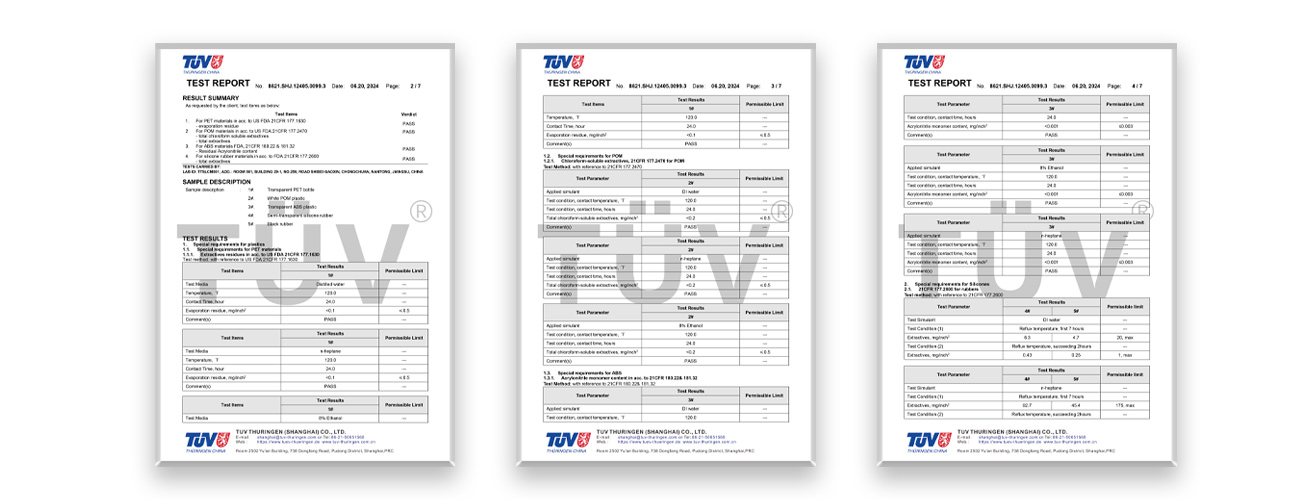
Soda Bottle Materials Compared: PET, Tritan, and Stainless Steel
The soda bottle is the component with the longest direct food contact duration in any household soda maker. Understanding the material options is essential for procurement decisions.
| Material | Composition | Key Advantages | Hongfeng Soda Bottle Compliance |
|---|---|---|---|
| PET | Polyethylene terephthalate | BPA-free by nature (PET synthesis does not use BPA); lightweight; transparent; high strength-to-weight ratio | LFGB: all migration levels n.d.; FDA: extractives <0.1 vs 0.5 limit |
| Tritan™ | Eastman copolyester | BPA-free; dishwasher-safe; higher impact strength than PET; heat-resistant | Optional premium soda bottle upgrade; available for brand differentiation |
| 304 Stainless Steel | Food-grade stainless steel | Zero organic migration risk; dishwasher-safe; fully color-customizable | No plasticizer/BPA concerns; requires heavy metals leach testing — Hongfeng stainless steel bottle meets all applicable standards |
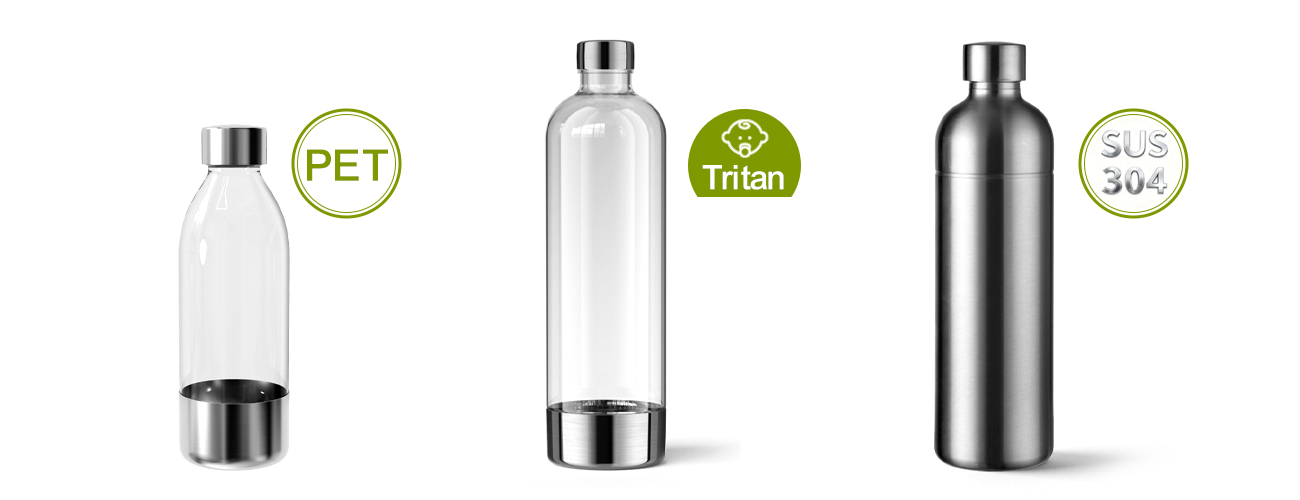
Every soda bottle in Hongfeng's catalog — whether PET, Tritan, or 304 stainless steel — is sourced from ISO9001-certified material suppliers. A poorly sourced soda bottle can undermine the safety profile of the entire household soda maker.
What This Means for B2B Buyers of Every Household Soda Maker
A TUV Thuringen test report covering 45+ models transforms the compliance conversation from a cost center to a competitive asset.
- One report, one audit. Instead of commissioning separate compliance testing for each SKU, a B2B buyer sourcing a household soda maker from Hongfeng inherits a compliance umbrella that already spans the entire product range. The soda bottle, the machine body, the silicone seals — every material has been tested under a single reporting framework.
- Legal defensibility. When a European regulator challenges a household soda maker's migration profile, or when a US retailer demands FDA substantiation for a soda bottle, a TUV report provides an immediate, authoritative response. It is the difference between "we believe it's safe" and "here is the lab evidence."
- Marketing-ready claims. "LFGB Certified," "FDA Compliant," and "BPA-Free — Laboratory Verified" are claims that belong on product packaging and listings — but only when backed by the reports that provide the legal basis. A household soda maker sold with these claims, supported by the test data, commands higher retail confidence and reduces downstream compliance friction.
Every sip of sparkling water from a Hongfeng household soda maker is protected by a compliance system that begins at raw material procurement and ends with a 21-page TUV LFGB report. The soda bottle that holds the water, the silicone that seals it, and the ABS body that houses it — every material has been independently tested and cleared. That is not marketing. That is manufacturing discipline.
Contact Hongfeng for the full LFGB and FDA test reports, product catalog, and tailored quotation. Email: hf@hfinnovation.cn.